Kurt's first words to me Saturday morning were, "What time do we go to the pig roast?"
He was going to have a long wait since we wouldn't be leaving home until late afternoon. The 11th annual Community Homestead Pig Roast is a fundraiser for the non-profit community living and working with people with special needs.
"A long time after lunch," I said.
The day passed slowly, and a few more questions, "Is it time to go yet?" were asked and answered before we finally left home.
After the 45-minute drive and parking the car in a farm field, Kurt, Paul and I walked to the community center. Kurt no longer hid his head like he did when we first started coming here seven years ago, but greeted every one, even yelling out to people some distance away.
There was an area blocked off on the left, as you can see in this picture. An electric fence was up and there were spray painted markings on the grass. I puzzled over it for a moment, but let it go. Later, I entered a raffle for a big basket of crafts made by the community members and chose the square "21," Kurt's age.
We had our meal of pork, applesauce, beans, potatoes and bread, (all homemade), in the makeshift dining area under the tents, in case of rain. Fortunately, the rain held off. We were lucky there was cloud cover because the temperature was 84 degrees and muggy.
I had invited John and Harriet Gushue. Fortunately, we found each other and we made room at our table. It was their first time. John mentioned he was interested in seeing the cowpie raffle. Puzzled, and hoping I didn't sign up to win a cowpie, I asked for more details.
Community Homestead is an organic dairy. Here are some of the cows out in the pasture:
Here's the cow that chose the winning number "12" in the fenced off area I had seen earlier:
We took a walk to the gardens and orchard to show our friends around. Kurt was more than happy to be tour guide. These are some of the flowers that are used to create bouquets and sold at farmer's markets.
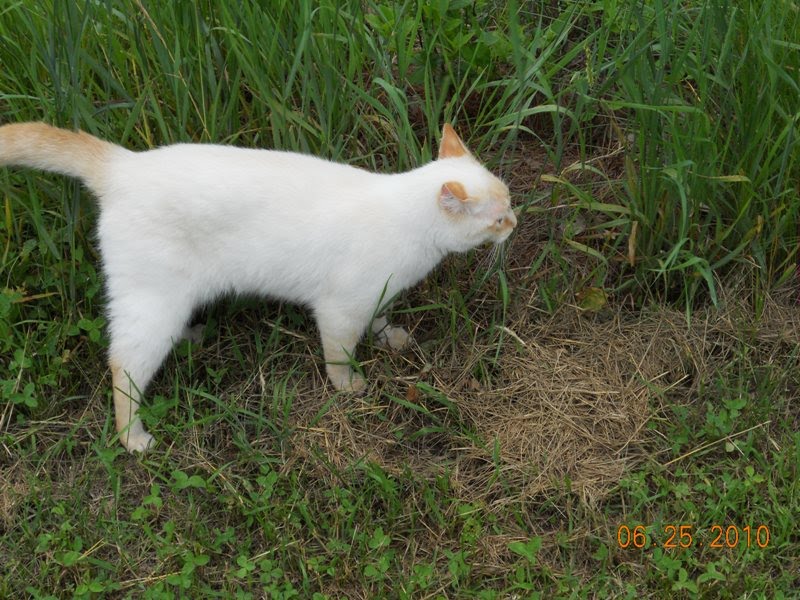
As we walked around to see the raspberry and blueberry bushes, a cat greeted us.
By the time we got back, the folk dancing had begun.
We had some sliced watermelon and watched the dancing before walking to the car.
Kurt said, "When do we come again for the pig roast?"
Logging life's lessons while caring for my medically fragile and cognitively disabled son.
Sunday, June 27, 2010
Sunday, June 20, 2010
The Boys
Many years ago, Paul and I were sitting in the living room reading the Sunday paper. Kurt was four-years-old and I was still trying to figure out how to be a parent of a special needs child. The neurologist had told us our son had a severe seizure disorder called Lennox-Gastaut syndrome. Not only would he have life-threatening seizures, but would also become developmentally delayed. I had spent many hours wondering what that meant for Kurt.
"Paul," I said, "how do you see Kurt's future?'
Paul shrugged.
"I mean, do you see him having a job and living on his own?"
"Maybe," he said, turning the page of the sports section.
Not giving up on a discussion, I said, "Do you see us getting the seizures under control?"
"Yeah, I hope so."
I was still dreaming that we would stop the seizures and Kurt would not be disabled. "I hope he catches up and everything will be fine." I sat for a moment, watching Paul read and waiting for him to jump in before I realized he thought the conversation was over. "What do you think Kurt's future will be like?"
He gave up and put the paper on his lap. "I think that Kurt will be Kurt."
"What does that mean?"
"You know, Kurt will be Kurt."
"No, I don't know what that means."
"Whatever abilities he has will be fine. I will love him no matter what," Paul said. "We don't know what progress he'll make and it doesn't matter, Kurt will be Kurt."
We sat silently then, and Paul turned back to the sports section. I stared blindly at the maple tree in the front yard. I was surprised by his acceptance. Yes, I would always love Kurt. But I felt this need to beat the tar out of epilepsy and find whatever methods he needed to learn.
Paul had been just as much an advocate for Kurt as I had. But this consent that our son might have a disability was beyond me.
What I have appreciated about that day and all the ones since, was Paul's devotion to our son and his complete acceptance of his abilities. He is a loving father to all three boys. While I am the parent who has high expectations for our sons, Paul is the parent who accepts them for who they are. It's a lesson I'm continually working on. He's been a great role model for me. He's been a loving dad.
Happy Father's Day Paul!
Happy Father's Day to all the dads of special needs children.
Saturday, June 12, 2010
A Party
Kurt told me he liked having his family around. Since his younger brother Kelly was graduating last weekend, we had company. My dad was visiting from Louisville, Kentucky and Paul's mom came from LaCrosse. In addition, Keith and his fiance, Jen, were here and my mom too, who lives near us.
There were many highlights to the weekend. One was that after the party, Kurt suggested we play his dice game. In Left, Right and Center, everyone starts with 15 cents. With each turn, the players must pass their nickels depending on the role of the dice. The last person with money wins. Kurt won four out of seven games and finished with a pocketful of change.
Here's a picture of Grandma Ruth, Kelly, Paul and Kurt.
There were many highlights to the weekend. One was that after the party, Kurt suggested we play his dice game. In Left, Right and Center, everyone starts with 15 cents. With each turn, the players must pass their nickels depending on the role of the dice. The last person with money wins. Kurt won four out of seven games and finished with a pocketful of change.
Here's a picture of Grandma Ruth, Kelly, Paul and Kurt.
Monday, May 17, 2010
On the Eve of 21
Kurt's 21st birthday is tomorrow.
Many thoughts are running through my mind:
- "If Kurt were a cat, he'd have eight lives left." That's how his neurologist put it when Kurt survived a drug-induced coma. He has lived 12 years longer than the doctors in the Pediatric ICU expected.
- The smallest steps since then have seemed like miracles.
- I have to remember when Kurt refuses to do something, that in the past, he may not have been capable of the task. Now he is, but the refusal is his strong will showing. That trait has been his saving grace.
- Over the years, I have come to accept that Kurt will never be independent because of his cognitive disability due tragically to the seven years of uncontrolled seizures. Kurt is working to prove me wrong. He wants to make his own decisions and I must learn to give him some space.
- He is on the cusp of his own version of independence.
Sunday, May 2, 2010
Sunday, April 25, 2010
Testing, 1, 2, 3...
Kurt has been tested several times lately regarding his stealing. I've discovered it is about impulse control. He wants something, so he takes it. He knows right from wrong, but he impulsively swipes the object of his desire anyway.
Things started clicking for me when I talked to our behavioral consultant. "Kurt needs to control his impulses so that he doesn't do risky behavior," he said. "I worry that he'll do something that puts him in danger."
So this is about more than stealing. This is about giving Kurt the opportunity to practice making the right choices, practice in becoming competent as an adult. It struck me that I had already done this with Keith, and I'm in the middle of it with Kelly, our 17-year-old high school senior. Teens are by nature impulsive.
Searching for "impulse control" and "teens" on the internet brought 79,000 hits. When I added "epilepsy" to the search, 344,000 links came back. Impulse control is regulated by the brain, from what I've read, and someone with epilepsy is at a higher risk of having problems controlling their impulses.
On Saturday, Kurt saw a pile of pictures I had gathered of his brother Kelly. "May I look at these?" he said.
"Sure." I was already impressed that he asked first. In the past, I would not have left them sitting out because Kurt would have been too tempted to take them. "But don't take them. I need them for Kelly's graduation party."
As we sat in the kitchen together, Kurt remarked over several of the pictures. "I wish I had this one," he said. Kelly was three-years-old, dressed as a fireman for Halloween. "I would put it in a frame in my room."
"I have to make copies. Would you like me to make you a copy?"
"Uh-huh," he said.
I was pleased with our conversation and the fact Kurt was willing to wait for something he wanted. Later, I found him downstairs with one of the pictures. "Did you take that?" I asked. "Remember? You weren't supposed to take any."
"I did take it," he said and handed it back.
This was practice, and admittedly, Kurt took a picture. But now I have some perspective. Keith made mistakes. Kelly makes mistakes. And they don't have epilepsy. It's going to take a lot of practice.
Things started clicking for me when I talked to our behavioral consultant. "Kurt needs to control his impulses so that he doesn't do risky behavior," he said. "I worry that he'll do something that puts him in danger."
So this is about more than stealing. This is about giving Kurt the opportunity to practice making the right choices, practice in becoming competent as an adult. It struck me that I had already done this with Keith, and I'm in the middle of it with Kelly, our 17-year-old high school senior. Teens are by nature impulsive.
Searching for "impulse control" and "teens" on the internet brought 79,000 hits. When I added "epilepsy" to the search, 344,000 links came back. Impulse control is regulated by the brain, from what I've read, and someone with epilepsy is at a higher risk of having problems controlling their impulses.
On Saturday, Kurt saw a pile of pictures I had gathered of his brother Kelly. "May I look at these?" he said.
"Sure." I was already impressed that he asked first. In the past, I would not have left them sitting out because Kurt would have been too tempted to take them. "But don't take them. I need them for Kelly's graduation party."
As we sat in the kitchen together, Kurt remarked over several of the pictures. "I wish I had this one," he said. Kelly was three-years-old, dressed as a fireman for Halloween. "I would put it in a frame in my room."
"I have to make copies. Would you like me to make you a copy?"
"Uh-huh," he said.
I was pleased with our conversation and the fact Kurt was willing to wait for something he wanted. Later, I found him downstairs with one of the pictures. "Did you take that?" I asked. "Remember? You weren't supposed to take any."
"I did take it," he said and handed it back.
This was practice, and admittedly, Kurt took a picture. But now I have some perspective. Keith made mistakes. Kelly makes mistakes. And they don't have epilepsy. It's going to take a lot of practice.
Sunday, April 18, 2010
Been There, Done That
We were nearly through our game when a mom and her special needs son arrived. "I think we are supposed to bowl on this lane," she said to me. Her son was tall and husky, much bigger than her and she kept control by lovingly holding both hands in hers. I recognized that move, having done similar with Kurt in the past.
So Sue and Nate joined us. We were bowling at the BRIDGE for Youth with Disabilities bowl-a-rama. The 16 lanes were full and loud music was playing over the crash of pins; general chaos all around.
Our team, like all the others, had a special BRIDGE bowler(Kurt was ours), three bowlers who had collected donations in the few weeks before this event(me, my mom, and friend Leann's son Shane), and University of Wisconsin - River Falls students who were mentors to the special bowlers. Our team had three students; Miranda was helping Kurt and the other two students, tall basketball players, didn't have any bowler assigned to them.
"Your turn to bowl Nate," I said.
Nate had a faint smile as he looked at me with his brown eyes. His mom followed closely as Nate picked up an orange ball, approached the lane and dropped it like a hot potato. It slowly rolled its way down as we all held our breath, hoping the ball wouldn't stop short. Finally, a few pins were gently toppled.
"Wade," I said to one of our students. "Would you help him so his mom doesn't have to?
He jumped up and took over. I remembered the relief I felt when students helped Kurt last year, our first time at this event. Kurt knew how to bowl, but needed to be told when it was his turn and having a student tell him was much easier for Kurt to take than having his mom do it. Besides, the students celebrated with him, offering high fives when he knocked down pins.
I could see Nate was a handful. He tended to wander in front of the other bowlers, and Wade began holding his hand to keep him in place. When Nate sat down, he would stretch his feet out and gently tap his shoes on mine, in some kind of secret connection I didn't object to.
Sue had a fervent look and attended to Nate's every need, on guard and ready for anything. I knew that look. I've worn it myself. When Kurt was on heavy doses of anti-seizure medications and having multiple daily seizures, his behavior was unpredictable. The noise in here alone may have had him bolting for the door. Or hiding out in the bathroom. Or he might have thrown a ball at someone or knocked everyone's drinks off the table. Being in public with Kurt required superhuman strength and I would be exhausted when we got home. As Kurt's behavior has improved, and because of the welcoming atmosphere of BRIDGE, I've learned to relax.
"So do you live in Hudson?" I asked Sue.
"Yes," she said. "Are you a volunteer?"
"No, that's my son," I pointed to Kurt. She glanced at Kurt as he prepared to bowl and looked back at me with new eyes. I hoped that she felt a little less alone. I know that BRIDGE helps me feel a part of the community.
As I reflect on the day's events, I can't help but think of Sue and all the parents who are dedicated to their special needs children. And all the caregivers and foster parents who choose to take this 24x7 job.
I know you do it out of love. You are amazing!
So Sue and Nate joined us. We were bowling at the BRIDGE for Youth with Disabilities bowl-a-rama. The 16 lanes were full and loud music was playing over the crash of pins; general chaos all around.
Our team, like all the others, had a special BRIDGE bowler(Kurt was ours), three bowlers who had collected donations in the few weeks before this event(me, my mom, and friend Leann's son Shane), and University of Wisconsin - River Falls students who were mentors to the special bowlers. Our team had three students; Miranda was helping Kurt and the other two students, tall basketball players, didn't have any bowler assigned to them.
"Your turn to bowl Nate," I said.
Nate had a faint smile as he looked at me with his brown eyes. His mom followed closely as Nate picked up an orange ball, approached the lane and dropped it like a hot potato. It slowly rolled its way down as we all held our breath, hoping the ball wouldn't stop short. Finally, a few pins were gently toppled.
"Wade," I said to one of our students. "Would you help him so his mom doesn't have to?
He jumped up and took over. I remembered the relief I felt when students helped Kurt last year, our first time at this event. Kurt knew how to bowl, but needed to be told when it was his turn and having a student tell him was much easier for Kurt to take than having his mom do it. Besides, the students celebrated with him, offering high fives when he knocked down pins.
I could see Nate was a handful. He tended to wander in front of the other bowlers, and Wade began holding his hand to keep him in place. When Nate sat down, he would stretch his feet out and gently tap his shoes on mine, in some kind of secret connection I didn't object to.
Sue had a fervent look and attended to Nate's every need, on guard and ready for anything. I knew that look. I've worn it myself. When Kurt was on heavy doses of anti-seizure medications and having multiple daily seizures, his behavior was unpredictable. The noise in here alone may have had him bolting for the door. Or hiding out in the bathroom. Or he might have thrown a ball at someone or knocked everyone's drinks off the table. Being in public with Kurt required superhuman strength and I would be exhausted when we got home. As Kurt's behavior has improved, and because of the welcoming atmosphere of BRIDGE, I've learned to relax.
"So do you live in Hudson?" I asked Sue.
"Yes," she said. "Are you a volunteer?"
"No, that's my son," I pointed to Kurt. She glanced at Kurt as he prepared to bowl and looked back at me with new eyes. I hoped that she felt a little less alone. I know that BRIDGE helps me feel a part of the community.
As I reflect on the day's events, I can't help but think of Sue and all the parents who are dedicated to their special needs children. And all the caregivers and foster parents who choose to take this 24x7 job.
I know you do it out of love. You are amazing!
Subscribe to:
Posts (Atom)
Kurt at 19
